The world’s great wine regions share more than just climate and tradition. They are characterised by landscapes profoundly shaped by viticulture. Terraces, retaining walls, steep slopes and winding paths define a territory where wine architecture cannot be seen as an isolated object – it forms part of the scenery, almost like another layer of the earth itself.
Today, wineries are no longer conceived purely as production facilities. They are spaces that engage with the terrain, the agricultural history, and even the experience of those who visit them. It is not just about making wine; it is about feeling the place.
It was precisely this approach that guided the design of the Quinta de Adorigo winery in the Douro Valley. Here, architecture does not impose itself on the landscape. On the contrary, it seems to emerge from it, following the natural curves of the land and the rhythm of the vine-covered terraces. It is a clear example of how building can mean integration rather than domination.

Architecture that merges with the landscape
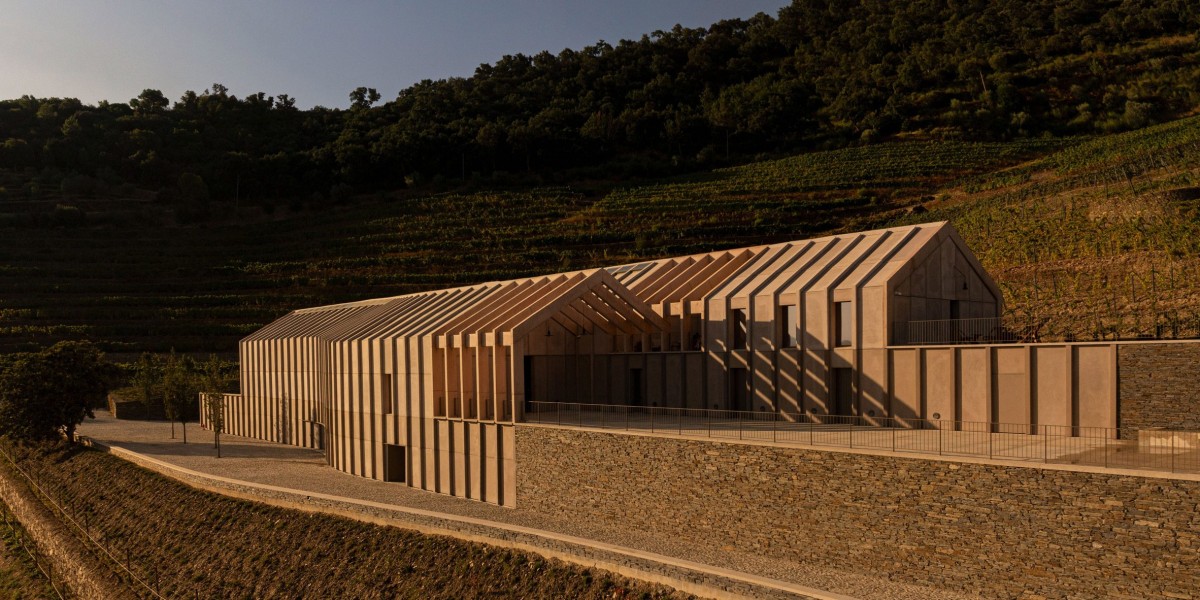
The Quinta de Adorigo winery rises in the Alto Douro Vinhateiro, a UNESCO World Heritage region renowned for its unique cultural landscape. Here, the studio of Sérgio Rebelo designed a series of wooden volumes with gentle curves, descending the hillside as if they were a natural continuation of the agricultural terraces.
The building forms part of a broader complex, currently under development, which will also include a hotel. Yet it is the winery itself that assumes the role of the project’s founding piece – the conceptual and architectural basis from which the whole ensemble takes shape.

The project is grounded in a direct reading of the place – and of the wine production process itself. It draws inspiration from the undulating contours of the vineyards and the gravity-fed winemaking system, organising production and visitor spaces along a descending sequence that naturally follows the slope.
“We explored many versions until we found something that felt organic, almost as if it had always been here. We wanted the building to merge with the landscape so that it was not clear where it began and where it ended,” explains the studio.
This intent translates into architecture that eschews iconic or flashy gestures, favouring a discreet, organic presence – almost topographical, more integrated than imposed.

The volumes rest on a concrete base clad in regional slate stone, partially excavated into the hillside. From this solid base rise laminated timber structures, filled with CLT panels and reinforced concrete elements strengthened with fibreglass.
The timber structure, deliberately visible both inside and out, evokes the “skeleton of a giant, ancient creature.” There is something almost organic about this solution, as if the building has grown from the ground itself.
Meanwhile, the double-pitched roofs reinterpret the traditional Douro barn archetype with a contemporary twist: the geometry is fluid and continuous, breaking the usual rigidity and giving the ensemble an unexpected lightness.

Journey through the production spaces
The interior layout of the winery reinforces the connection between architecture, production and sensory experience. Here, nothing is left to chance. Grapes enter at the highest level of the building and then follow a descending path through circular openings that allow work by gravity.
This system reduces the need for mechanical intervention and directly links the architecture to the traditional Douro wine logic. Essentially, the building itself follows the natural course of winemaking, almost as if it were part of the harvest.

Visitors begin their journey at the building’s lowest point, entering through a shop described as “cave-like.” From there, an exposed concrete staircase leads the curious up to the heart of the project: the large ageing hall.
This central space, with a double-height ceiling and flooded with natural overhead light, houses the industrial vats and barrels. Surrounding it, steel balconies and a glass-enclosed tasting room suspended above the production process allow visitors to observe everything up close – almost as if they were inside the wine itself as it transforms.
The fact that this area is partially underground and enclosed by stone retaining walls is not purely an aesthetic choice. The thermal mass created by this solution helps maintain stable temperature and humidity levels – essential for wine ageing.
“This part of the space is very similar to a church, about 10 metres high with natural light entering from above. In a way, it gives the hall a very particular spirituality and a special connection to timelessness,” explain the project team.
Like a temple, this hall becomes a place of contemplation. Here, wine is understood as a slow, almost ritualistic process, deeply connected to time and the surrounding landscape.