3D printed houses are already a reality in several countries across the world, and now they promise to revolutionise the construction sector in Portugal. Several companies are already using 3D technology to build houses and one of them is Litehaus which was founded in 2024. Its most recent project is a 3D house to be built in Comporta and designed by Portuguese architect Rui Marta Barbosa, who recently won a competition launched by the company. In addition to this new housing project, the young company plans to build 100 3D houses a year in Portugal 70% faster and 20% cheaper than traditional housing.
At the beginning of March, Litehaus launched its "Design the First 3D-Printed House in Portugal" competition, aimed at architecture students and professionals living in Portugal who wanted to take on the challenge of designing a 3D-printed house for a development in the Comporta area, near Melides. And now we know who the winner of this competition is: Portuguese architect Rui Marta Barbosa, from Openbook, who will receive a prize of 5,000 euros, according to a press release.
"It was with great enthusiasm that I took part in this challenge launched by Litehaus and I feel very honoured to see my project selected as the winner. In my proposal, I endeavoured to combine this new construction method with modular repetition, which is easy to adjust to the various needs of future users and the challenges created by the surrounding environment. I endeavoured to combine contemporary elements with the traditional architectural language of Melides, always respecting the urban context," comments architect Rui Marta Barbosa, quoted in the document.
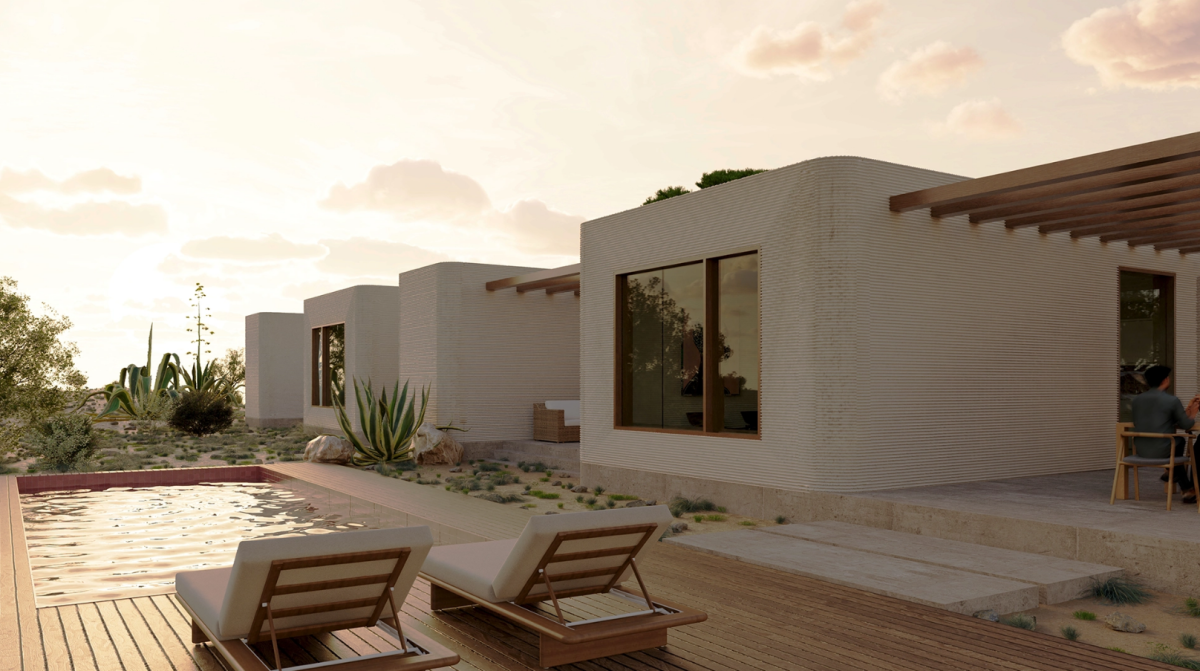
But what will this 3D house in Portugal printed by Litehaus look like? Inspired by the warm colours of the beaches and streets of Comporta and Melides, this 3D house is based on modular architecture, so it's "easy to vary between a 1, 2 or 3 bedroom property, with more or fewer social spaces, on a larger or smaller plot of land", they explain on their website. Thus, the layout and number of rooms in the house can be organised and adjusted according to the owner's wishes and the area of the plot. In addition, the architectural project also includes a swimming pool, which has tiles that give the water a reddish colour.
3D house building to grow in Portugal at affordable prices
The market for building 3D houses could grow by 88 per cent a year and could even be worth up to 400 billion dollars by 2030. It is in this context that Litehaus says it wants to be part of this evolution, with plans to build 100 3D houses in Portugal per year.
This new 3D house designed by the Portuguese architect will then form part of a housing network to be developed by the company. "With the aim of building 100 properties a year in Portugal, we're going to complement the residential unit of 13 houses in Torres Vedras with this new project in Melides. At the same time, we have another 50 projects planned for Torres Vedras, 73 modular tourist flats in Braga and we are currently close to closing a development of 108 student accommodation units in Famalicão," says Simi Launay, Litehaus' Chief Creative Officer, quoted in the document.
That's why, over the next two years, Litehaus plans to hire ten more employees to create "a more accessible and sustainable future in construction and architecture in Portugal, developing energy-efficient units with lower running costs for buyers," they explain.
Advantages of building 3D houses
The construction of 3D houses has several advantages over traditional construction. Firstly, the houses are built much more quickly and are also more sustainable, since 3D printing technology - which in the case of Litehaus is supplied by Spain's Cosmos - allows 45 m2 of walls to be erected in less than 24 hours, consuming 70 per cent less energy and producing 90 per cent less waste. What's more, the walls are built using a material that replaces cement and produces between 40 and 50 per cent fewer CO2 emissions. In this sense, "Litehaus predicts that within five years it will be building at a price 50 per cent lower than traditional manufacturing," they add.