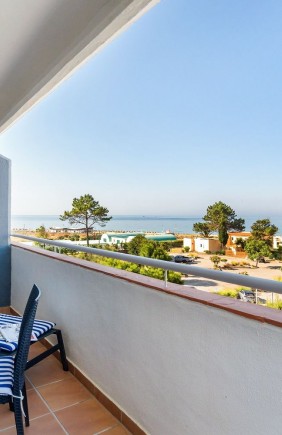
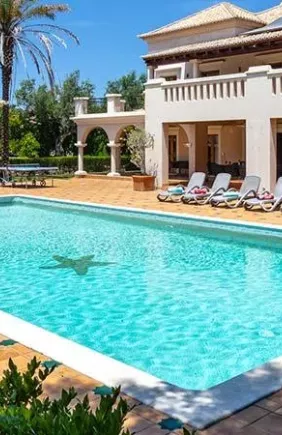
This summer, many families will look out at a sea-view balcony and start thinking about buying a holiday home. It’s the same idea every year: a sunny retreat, a guaranteed place for holidays, a slice of summer that belongs to you.
But a holiday home is paid for all year round and used for only a few weeks. You buy a piece of summer and take on a full year of obligations. Is it really worth it?
- Why is the holiday home still such a Portuguese dream?
- What does it actually cost to maintain a holiday home?
- Is IMI higher on a second home?
- Is it harder to get a mortgage for a second home?
- Renting it out when you’re not using it: does it really pay off?
- Coast or countryside: where does it make more sense to invest?

Why is the holiday home still such a Portuguese dream?
The reasons are almost always the same: a long-held dream waiting to be fulfilled, the convenience of being a short walk from the beach in August, and the desire to escape the pace of city life. Estate agents add the investment argument: buying a holiday home as an asset that can generate returns, either through short-term lets or long-term appreciation.
Yes, a holiday home can be an investment. But investing in one without doing the sums is often the first step towards regret.
What does it actually cost to maintain a holiday home?

Much more than the mortgage repayment. Expenses continue month after month, even when the property is closed up. Imagine a two-bedroom flat twenty minutes from the beach, bought for €250,000.
Over the year, the costs might look like this:
IMI (municipal property tax): between €450 and €700, depending on the municipality and the property’s taxable value.
In 2026, the rate for urban properties ranges between 0.3% and 0.45%.
Condominium fees: for a typical flat, around €40 to €80 per month, roughly €700 per year.
It can range from €20 to over €150 per month, according to Doutor Finanças.
- Insurance: home insurance and, if there’s a mortgage, associated life insurance, easily several hundred euros a year.
- Water, electricity and communications: fixed charges don’t disappear just because the house is empty.
- Maintenance: a common rule of thumb in the sector is around 1% of the property’s value per year, more for homes near the sea, where salt air causes wear and tear.
Before even factoring in mortgage repayments, it’s easy to reach several thousand euros a year for a property that sits unused. Spread across the weeks you actually stay there, the cost per night can exceed that of a good hotel.
Is IMI higher on a second home?

There’s a myth worth clearing up. The IMI rate is set by each municipality and applies to the property itself, regardless of it being a main or second home.
- In 2026, it ranges between 0.3% and 0.45% for urban properties. In other words, IMI on a second home does not have a higher standalone rate.
What changes are the tax benefits. The temporary IMI exemption for up to three years and the family IMI deduction apply only to a main and permanent residence. A second home cannot access these reductions and may even face a higher rate if used for local accommodation.
In practice, IMI on a second home tends to weigh more heavily, even with the same percentage. At the time of purchase, the difference is clearer still: a main residence benefits from an IMT exemption up to €106,346 in 2026, while on a second home the tax is due from the first euro.
In summary:
- IMI: same municipal rate (0.3% to 0.45%), but no temporary exemption or family deduction, and a possible surcharge for local accommodation use.
- IMT: no exemption as with a main residence; charged from the first euro, at 1%.
- AIMI: applies to owners whose total taxable property value exceeds €600,000 per person.
- Overall, taxes on a second home tend to be higher than on the home you live in.
Is it harder to get a mortgage for a second home?
A mortgage for a second home differs straight away in the required deposit. Under Bank of Portugal rules, a bank can finance up to 90% of the value when buying a main and permanent residence, but for a second property, the maximum tends to be around 80%.
- In practical terms, for a €250,000 two-bedroom flat, that means finding around €50,000 in own funds rather than €25,000.
In 2026, the European Central Bank has kept its key rates at 2%, and Euribor has broadly followed, which has made monthly repayments more manageable.
Even so, when taking out a mortgage for a second home, the rule remains the same: allow for the possibility of interest rates rising again and avoid basing calculations on the most optimistic scenario.
Before completion:
- Deposit: around 20% of the value, compared with the 10% sometimes possible for a main residence.
- Purchase taxes: IMT (charged from the first euro), Stamp Duty of 0.8% on the purchase and 0.6% on the financed amount.
- Deed and registration costs: paid from your own funds, not added to the loan.
- Interest: in 2026, Euribor is close to 2%, but it’s sensible to model a higher rate.
Renting it out when you’re not using it: does it really pay off?

First, it’s a question of location. Investing in a holiday home on the coast, particularly in the Algarve, benefits from strong tourist demand.
- The region accounted for around 30% of national overnight stays in 2023, which makes short-term letting possible for much of the year. The trade-off is paying the highest entry prices in the country.
- A holiday home in the interior presents the opposite scenario: a lower purchase price, but a more limited rental market and potentially slower resale.
Renting can help cover costs, but it brings tax obligations that need to be understood before deciding. The key issue is the type of rental, which can turn a retreat into a long-term commitment.
- Local accommodation (alojamento local): registration, activity declared with the tax authorities, inspections and specific rules; allows continued personal use outside the high season.
- Residential letting: taxed at 25%, dropping to 10% under affordable rent schemes, but requires a long-term contract and giving up personal use.
- In both cases: rental income is taxable and must be declared.
Coast or countryside: where does it make more sense to invest?
Unlike a main residence, selling a holiday home almost always involves tax. For residents, half of the capital gain is added to other income and taxed at your personal IRS rate.
In an example reported in the press, a house bought for €70,000 and sold for €180,000 could generate around €14,800 in tax, after applying coefficients and allowable expenses. The headline profit is not the amount that ends up in your pocket.
Since 2026, there has been an exception. Decree-Law no. 97/2026 allows this tax to be avoided if the proceeds are reinvested in a property for affordable rental. It resolves the tax bill but requires changing the intended use of the property.
Coast and countryside, in brief:
- Coast: high entry cost, strong demand, easier resale.
- Interior: lower purchase price, more limited rental and resale prospects.
- On sale: 50% of the capital gain taxed under IRS, unless reinvested in affordable rental under Decree-Law no. 97/2026.
Stay in the know about all things Portugal—get our weekly newsletter for the latest travel, legal, and lifestyle news.