For foreigners, Portugal continues to be a destination of choice to buy or rent a house. The mild climate, quality of life, safety and leisure activities that the country appeals to those who are choosing the country as their new home. And then there are programmes and tax regimes designed by the Government, which attract foreigners and digital nomads to live Portugal and even invest in a house in exchange for a residence permit.
Added to this is the lower cost of living in relation to their income level, as well as residential property prices, which despite having escalated in recent years and being increasingly unaffordable for Portuguese families, are still sometimes lower than the values registered in their countries of origin.
The truth is that neither the pandemic (which has changed the criteria for house-buying), nor the war in Ukraine - which is reducing purchasing power and increasing interest rates on mortgages - have cooled the interest of foreigners in buying houses in Portugal, from various parts of the world, like Brazil, the USA or France. And proof of this is that the average weight of international demand in the 20 Portuguese district capitals is around 27% both at the end of 2019, and at the end of 2022. And in the rental market there was even greater international demand in December 2022 (32%) than before the pandemic (24%), with Brazil being the main market responsible for this dynamic, idealista data shows.
Demand for houses for sale by foreigners: how did it vary by area?
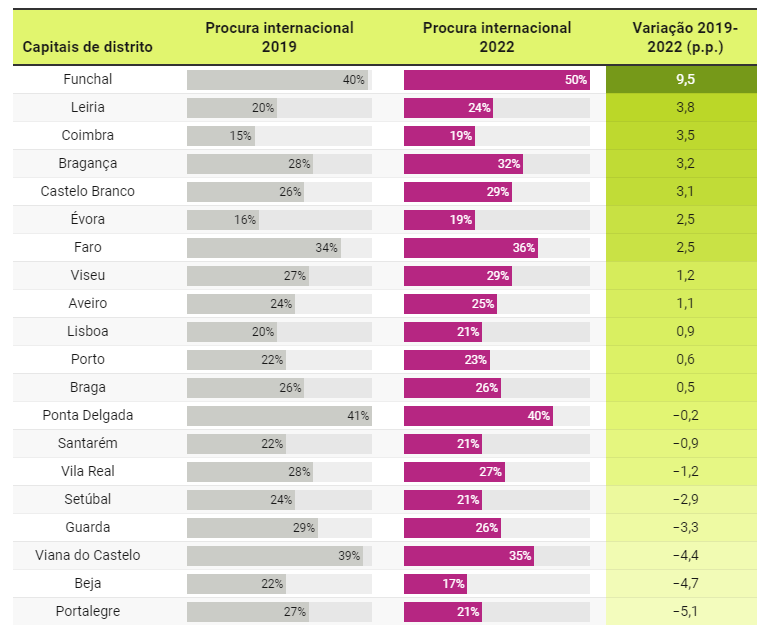
Although the international demand for houses to buy has stabilised nationally, there were 12 district capitals where this demand rose and eight cities where it fell between 2019 and 2022. It was in Funchal where the growth was most expressive (9.5 p.p), now representing about 50% of the total demand for houses in this city last December. Foreigners also gained interest in purchasing homes in Leiria (3.8 p.p.) and Coimbra (3.5 p.p.). In Portalegre and Beja, on the other hand, the international demand for houses fell the most.
Besides the Madeiran capital, the demand for houses from the external market is very expressive in Ponta Delgada, representing 40% of the total in December 2022 (note that 60% of demand is national). Also in Faro, Viana do Castelo and Bragança, one in every three people looking to buy a house is of foreign origin. On the other hand, Beja, Évora and Coimbra are the cities in the country that seem to attract the least foreigners to buy a house, according to the same data from idealista.
The graphic below shows the evolution of demand for property for sale in Portuguese cities by foreigners.
Foreigners buying property in Portugal: where are they from?
The houses for sale in the 20 Portuguese district capitals are in the sights of citizens from the most different countries. The most active in recent months have been from the Brazilian, North American and French markets, the data shows.
- In Lisbon, foreigners represented 21% of the total demand for houses to buy in December 2022 (+0.9 p.p compared to the end of 2019). Here the demand is mainly felt by North Americans, Brazilians and Spaniards;
- In Porto, one in five people looking for a house to buy was of foreign origin (+0.6 p.p. compared to 2019). In the invicta city, those who look for more houses are citizens from Brazil, USA and Spain.
- In Faro, international demand represents 36% of the total (+2.5 p.p. than before the pandemic). And in the Algarvian capital, the people looking most for houses to buy are Germans, British and North Americans.
What's so special about Portugal that attracts more and more foreigners?
The most recent data from the INE (National Statistics Institute) on house prices shows that foreigners pay around 50% more per square metre for their homes than the Portuguese. And there are many reasons why foreigners buy houses in Portugal. Some are looking for a second home - to live in, spend their holidays in or even as an investment - where they can enjoy the quality of life, gastronomy, beaches and landscapes that Portugal has to offer.
And many take advantage of the tax regimes for foreigners that exist in the country, with the non habitual residents regime, visas for digital nomads and the golden visa programme - even though the Government is studying the end of residence permits for investment.
But many foreigners are also looking to live in a peaceful environment, taking refuge from the political, social and economic instability that has taken hold in various countries around the world, such as the USA, Brazil, the UK and countries that are close to the armed conflict between Russia and Ukraine. In addition, "the current war scenario has brought several Russian clients, who have fled the regime, and also Ukrainians, who see Portugal as a safe haven for their families", as Rafael Ascenso, CEO of Porta da Frente Christie's, stated in an interview with idealista/news.
The analysis done by idealista/data shows that foreigners continue to be interested in buying and renting homes in Portugal, despite the current economic and political context marked by:
- High inflation: although it fell to 8.3% in January, it is well above the price stabilisation level (2%);
- Rising interest rates on mortgages: this is cooling demand for new contracts in Portugal and the Eurozone, along with a loss of consumer confidence and low expectations regarding the evolution of the residential market
- High prices of houses to buy and rent: although price growth in the purchase and sale market is already slowing down in half of the major Portuguese cities, according to the INE
- Gold visa controversies: besides the delays in obtaining residence permits, António Costa's Government is studying the end of the programme;
Added to all this is the initiative of the Left Bloc, which recently presented a bill to prohibit non-resident foreigners from buying houses in Portugal, inspired by a measure already applied in Canada, New Zealand, and which is under study in the Balearic Islands (Spain), with the aim of putting a brake on the rise in prices of houses for sale.