Foreign demand in Portugal’s property market remains highly regional. The latest Engel & Völkers market data points to particularly international buyer bases in certain resort areas, while Porto, the Oeste and Minho each attract different nationalities.
For people planning a move or longer stay in Portugal, the figures underline a practical point: the experience of buying property can vary widely between regions, as can the balance between local and overseas demand.
Portugal property market 2026: the headline figures
Engel & Völkers’ Market Report Portugal 2025–2026 records the largest shares of international buyers in Cascais and several Algarve locations.
Location | International buyer share | Main foreign nationalities named |
|---|---|---|
Cascais | 81.3% | Brazil, Russia, United States |
Quinta do Lago and Vale do Lobo | About 80% | United Kingdom, Ireland, Germany, Belgium, Netherlands |
Vilamoura | 75% | Germany, Netherlands, Belgium |
Oeste region | 55% of Engel & Völkers sales | United States, France, Germany |
Vila Nova de Gaia | 33% | United States, United Kingdom, France |
Porto | 27% | United States, France, Spain |
Cascais and the Algarve lead for international demand
In Cascais, 81.3% of property sales were made to international buyers. Brazilian, Russian and American buyers were the nationalities most prominently represented in the data.
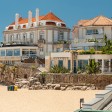
Cascais and nearby Estoril are also described in the wider Engel & Völkers study as sought-after locations for higher-income domestic and international families. The housing supply includes sea-view apartments and villas in gated communities.
Quinta do Lago, Vale do Lobo and Vilamoura
In the Algarve’s central resort market, about 80% of buyers in Quinta do Lago and Vale do Lobo are international. British and Irish buyers feature prominently, alongside buyers from Germany, Belgium and the Netherlands.
Vilamoura reports a similar pattern: 75% of buyers are international, led by Germans, Dutch and Belgians. The study identifies its marina infrastructure and golf courses among the features associated with its market position.
The wider Algarve market is described as Portugal’s most internationally established coastal property market. International demand is concentrated in the Vilamoura, Albufeira and Lagos triangle.
Eastern Algarve remains distinct
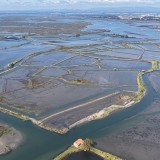
Tavira, Olhão and the Ria Formosa — the protected coastal lagoon system in the eastern Algarve — are identified as areas where prices remain significantly below those in the central and western Algarve.
The source says these locations have been drawing national and international buyers with a longer-term investment perspective.
American buyers feature strongly in Porto, Gaia and the Oeste
Porto remains mainly a domestic market
Portuguese buyers account for 73% of the Porto market in the Engel & Völkers data, while international buyers represent 27%.
Among foreign purchasers, Americans are the largest group, followed by French and Spanish buyers. Porto is described as a market with prices below Lisbon and a significant rate of appreciation.
The historic centre remains the segment most sought after by investors and international buyers. Cedofeita, Bonfim, Miragaia and Vitória are among the neighbourhoods cited.
Vila Nova de Gaia has a larger foreign-buyer share
Across the Douro from Porto, Vila Nova de Gaia has a foreign-buyer share of 33%, compared with 67% for domestic buyers. Americans, Britons and French buyers are the main overseas nationalities named.
The Oeste records a foreign-buyer majority
The Oeste region recorded 55% of Engel & Völkers transactions with foreign buyers. Americans again make up the largest overseas group, followed by French and German purchasers.
The study cites the area’s proximity to Lisbon, quality of life and still-competitive prices as factors in its appeal. It also notes that the region has become more prominent in the international residential market.
Minho’s market has a strong British presence
In Minho, British buyers represent 95% of investors, according to the Engel & Völkers report. They are particularly seeking houses.
The source links the region’s appeal to quality of life, heritage and rising values. This is a much more concentrated nationality profile than in markets such as Cascais, Porto or the Algarve.
Other Portugal real estate investment areas cited for growth
The study points to several locations where pricing, regeneration or changing demand patterns are shaping interest.
Lisbon’s riverside districts and metropolitan alternatives
Lisbon remains Portugal’s most dynamic and liquid property market, as well as its most expensive, according to Engel & Völkers.
- Alcântara, Belém and Ajuda have received public and private investment in recent years and are described as retaining room for appreciation.
- Alvalade, Campo de Ourique and Amoreiras are cited as comparatively more accessible than the historic centre, with a positive appreciation trend.
- Almada, Setúbal and the Setúbal Peninsula are identified as places with accessible prices within less than half an hour of Lisbon.
Eastern Porto and Matosinhos
Campanhã and Lordelo, in eastern Porto, are described as having more accessible prices and potential for appreciation. The study links this to regeneration schemes and expansion of the metro network.
Matosinhos, meanwhile, has seen growth in demand and prices. Its sea access and proximity to Porto Airport are among the features cited.
Alentejo coast, Madeira and São Miguel
Comporta is described as one of Portugal’s most exclusive property destinations, with values comparable to leading addresses in the Algarve. The study states that the lower-priced market there no longer exists.
Further south on the Alentejo coast, Melides, Vila Nova de Milfontes and Zambujeira do Mar are presented as areas with more room for appreciation over the medium to long term.
In Madeira, Funchal and surrounding areas are described as the island’s most liquid markets, with consistent price appreciation and diversified international demand. In the Azores, São Miguel has attracted growing attention from domestic and overseas buyers, according to the study.
The findings, based on those in the idealista article 'Mapa de investidores imobiliários no país é cada vez mais diverso', show that foreign property buyers in Portugal are not following one uniform pattern.
Stay in the know about living in Portugal as a foreigner—get our weekly newsletter for the latest travel, legal, and lifestyle news.